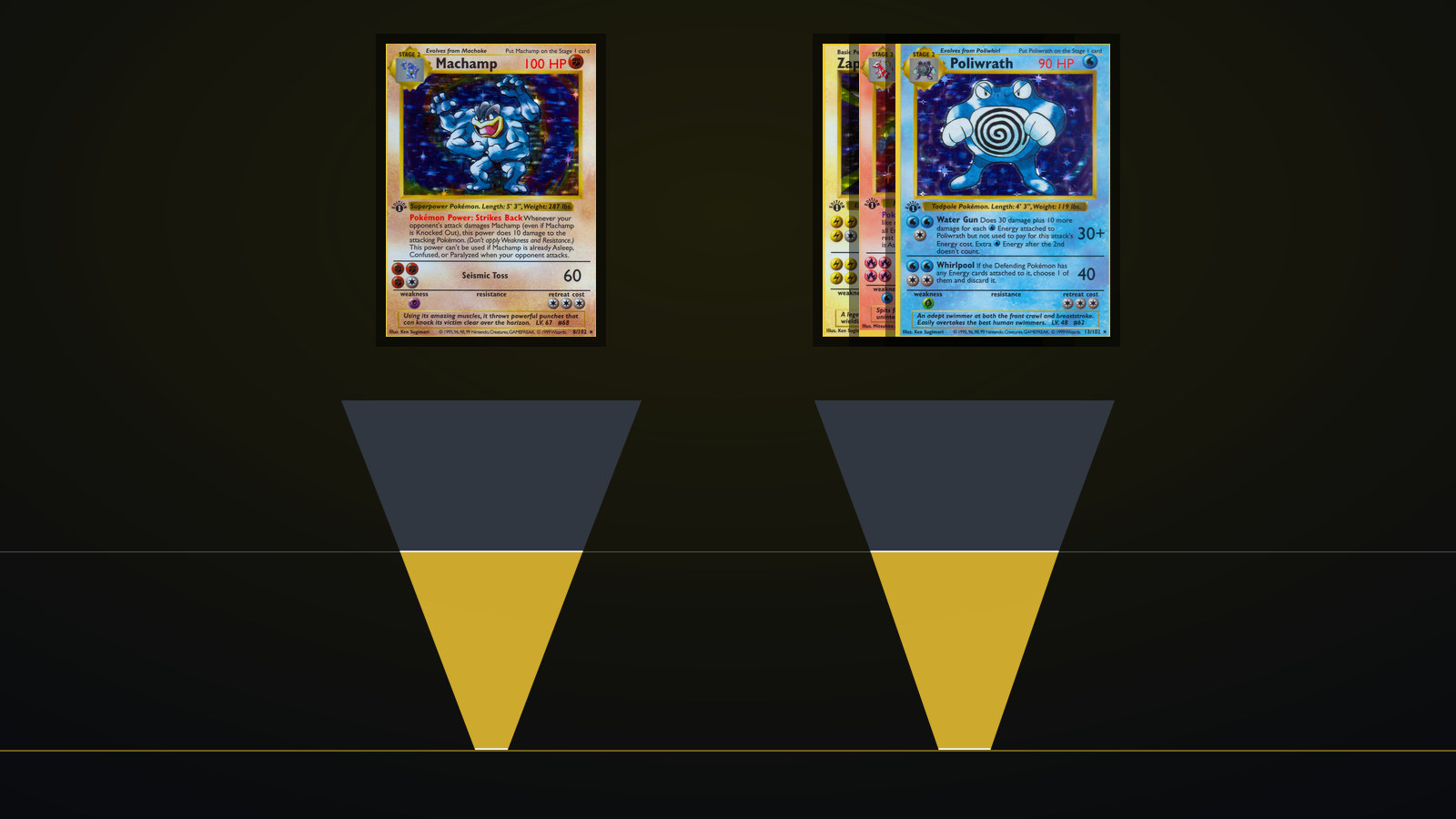
Machamp, card 8 of 102 in the English Base Set of January 1999, holofoil print, is graded on its cut rather than on anything printed inside its yellow border. The Base Set Machamp is capped at the factory rather than in the hands of the people who owned it, and the fifteen holofoil rares printed with the identical face are the evidence, because the card reaches a PSA 8 at close to their rate and then stops. The 1st Edition Machamp PSA 10 count stands at 429 copies against 36,968 graded submissions, a gem rate of 1.2 percent. Those fifteen sheetmates pooled return 3.0 percent across 45,341 submissions of their own. I sorted the sixteen rows of that block several ways this week, and on every measure that touches the top grade the Machamp finished last of the sixteen. The question worth a column is which physical mechanism does it, and the printed face rules out most of the usual suspects before any counting starts.
The deck that carried the sixteenth holofoil rare
Base Set reached English shelves on January 9 of 1999, a date I read this run off two independent records, the pokemon-tcg-data card dump and TCGplayer's own group listing for the set. The set holds 102 cards and sixteen holofoil rares, and the census carries an unstamped unlimited print of fifteen of them. It carries no unstamped Machamp at all, which is what a holofoil rare looks like when it never entered the booster run. The sixteenth arrived a different way, inside the boxed 2-Player Starter Set, whose deck list in that same dump carries exactly one holofoil Machamp among its nineteen entries. That list is the reason this comparison is possible at all, because it marks one card of the sixteen as having left the factory inside a different package. The familiar account in the hobby is that the starter set stayed in production long after the booster runs had moved on, and I found no printing document of any kind to support it, so it stays lore here. What the census does show is a stamp behaving nothing like the stamp on the other fifteen cards.
Four prints, and the designation every one of them carries
The census files the holofoil Machamp under four separate prints, and every one of them carries a first edition designation. The largest is the plain first edition print at 36,968 graded copies. Behind it sit the print the census labels first edition shadowless at 7,985 copies, the 1999 to 2000 copyright print at 278 copies, and a fourth print filed under a product dated the following year, the 2-Player CD-ROM Starter Set, at 3,147 copies. No unstamped English holofoil Machamp row appears anywhere in the census I read. On the other fifteen cards that stamp separates a small early print from a much larger later one, which is why a stamped Charizard and an unlimited Charizard are two different objects to a collector. On this card it separates nothing at all, because the mark rode the whole production run and carried on into a product dated a year after the set. A designation that every surviving copy carries cannot be the thing that makes any copy of it scarce.
The fifteen cards printed with the identical face
I opened the official scans of all sixteen holofoil rares this run and set them beside one another at the same size. The frame is the same on every one, and the yellow border runs at the same width. The artwork window sits in the same place on each of them, and the Cosmos foil fills that window and nothing else. That is the same foil treatment that later covered a whole reprint set, which I took apart in the piece on the Base Set 2 Blastoise and the Cosmos foil it wore. The card stock is common to all sixteen, the year of manufacture is common to all sixteen, and so is the grading company that read them. Everything a collector normally blames for a Wizards of the Coast era grade is therefore held still across this comparison, including the surface area of the foil, the width of the border that whitens, and the shape of the corners that chip. What is not held still is the press run that made the Machamp and the package its copies travelled in. That is the whole design of the reading, and I know of no cleaner version of it anywhere else in the English Base Set.
Where the 1st Edition Machamp PSA 10 rate actually lands
Ranked by gem rate from the worst upward, the Machamp is number 1 of the 16 holofoil rares in the block. The plain gem rate divides by every copy ever submitted, so on a card from 1999 it measures how the surviving copies were treated as much as how they were printed, which is the correction I ran on the secret rares in the piece on conditioning a Skyridge census on reaching a PSA 8. The same correction applied here leaves the Machamp exactly where it was. Of the Machamp copies that reached a PSA 8 or better, 3.1 percent came back a ten, against 7.6 percent for the fifteen pooled. The weakest of those fifteen on that measure is Chansey at 4.5 percent and the strongest is Zapdos at 10.6 percent, so the Machamp lands under a floor the rest of the block never reaches. The submitted copies are not unusually beaten, with 37.2 percent of everything mailed in reaching a PSA 8 against 39.4 percent for the fifteen. Where the card differs is one grade further down, with 53.0 percent of its gradeable copies stopping at the PSA 8 line against 45.2 percent of theirs.
The same shortfall, counted again on the other large print
A single comparison on a single print can always be an accident of who chose to submit what, so the useful test is whether the shortfall repeats somewhere independent of it. The census carries a second large Machamp print and a matching block of fifteen to read it against. The print it labels first edition shadowless holds 7,985 graded copies, and the fifteen cards it labels shadowless hold 85,157 copies between them. Those shadowless Machamp copies are in far worse shape than that block, with 18.9 percent reaching a PSA 8 against 27.7 percent for the fifteen cards beside it. Even so, among the copies that did reach one, the Machamp returns 1.3 percent tens against 3.2 percent for the fifteen. That is a different print with a different submitter pool and a far more beaten population, and the shortfall still points the same way by roughly the same distance. Submitter selection would have to bite equally hard on two populations in very different condition to account for both readings, which is possible and which the repeat makes harder to hold.
What a different cutting run changes and what it does not
Holofoil scratching is the mechanism collectors reach for first on a card of this era, and it cannot carry a gap of this size, because the same Cosmos foil in the same window sits on all sixteen of them. Border whitening and chipping fail the same test, since the yellow border is one colour at one width on every card in the block, cut from one stock in one year. Edge wear from stacking belongs to the owners rather than to the press, and the share of copies reaching a PSA 8 has already shown the Machamp copies to be in ordinary shape for this block. What a separate press run genuinely changes is the trimming, and centering is the one mechanism of the era that a different cut moves without touching a single printed element on the face. Trimming is therefore what this reading leaves standing, and the census supports it only to the extent that it puts the loss on copies clean enough to reach an eight. The long standing account that the starter set Machamp runs off centre more often than its sheetmates agrees with that, and it is lore rather than record, because no cutting document from 1999 has ever been published. A surface fault laid down at the press, a print line or a misregistered foil layer, survives the same elimination, so the conclusion stays narrower than a single named defect.
What this census cannot settle
Submitter selection is the living objection to all of this and it is not fully answered, because a Machamp is a cheap card and cheap cards get mailed in marginal condition. Conditioning on reaching a PSA 8 removes the crudest version of that effect, the repeat on the second print argues against most of the rest, and neither step removes it completely. The census cannot separate a trimming fault from a surface fault laid down in the same run. The mechanism is therefore located at the press in this piece rather than named outright. It records nothing about where a card sat on its printing sheet, so nothing here can say whether the fault lived in one corner or ran across the whole of it. The figures above are live rather than historical, with 515 copies added to the Machamp census in the last thirty days, so the comparison re-reads itself every time this page is rebuilt. The arithmetic behind each of those measures sits on the page documenting how every figure on this site is put together.
Fifteen dollars, and a product that cannot price the top
I pulled the completed sales table for the card on October 14 of 2026 rather than repeating a headline figure off the top of the page. The ungraded side of it is dense and consistent, with 38 recorded sales running from 2.25 dollars to 30.38 dollars and a median of 15.70 dollars, most of them inside the last fortnight. The top of the same table is a different matter, and no PSA 10 figure comes out of this piece. Three prints share that one product page, and its completed rows include a copy described as shadowless and a copy described as neither, sold on the same day in August of 2026 at 8,100 dollars and at 4,500 dollars. A row from September of 2026 describes a third copy as coming from the 2000 CD-ROM set. A median taken across a table like that would average three different cards together at three different price levels, so no such figure appears here. Nothing here is financial advice, and a graded card from 1999 is a speculative and thinly traded thing to own.
What survives of this card is simple enough to describe and hard enough to find. The Cosmos foil in the window holds up as well as it does on any of the fifteen, because it sits under the same coating and was never the weak point. The yellow border on a clean copy is bright, and the four edges show the ordinary dark flecking of a card trimmed in 1999. At arm's length the face is indistinguishable from a Charizard or a Zapdos out of the same block, which is the entire point of the comparison. The surviving copies carry an intact foil and a square yellow border, and the thing holding them one grade short of the cards printed beside them is a cut that no amount of careful storage ever repaired.